Customer Support Is Your Best Growth Lever: The ROI Most SaaS Teams Ignore
Customer support isn't a cost center - it's a growth engine. How SaaS teams measure support ROI, cut churn, and turn tickets into revenue signals.
In this article
-
Not a Cost Center: Customer support is a growth lever, not an expense line. Companies that treat it as strategic retain customers at measurably higher rates.
-
Retention Economics: A 5% improvement in retention can increase company valuation by 25% to 95%. Support quality is the fastest path to that improvement.
-
Revenue Signal: Support interactions generate the richest signal for expansion revenue, churn risk, and product direction. Ignoring that data is leaving money on the table.
-
AI Multiplier: AI-driven support is cutting ticket volume by 25% to 45% and delivering 2x to 5x ROI in year one, but only when layered on top of a strong support foundation.
-
Unit Economics: Self-service costs $0.10 per contact versus $8.01 for live channels. Building the right support mix directly improves your margins.
-
NRR Driver: Companies with dedicated customer success teams see up to 25% higher net revenue retention. Support is where expansion conversations start.
There is a line item on every SaaS P&L that leadership looks at with suspicion: customer support. Headcount goes up, budgets get questioned, and the first instinct during a downturn is to cut.
I have watched this happen. I have also watched what happens after those cuts: churn climbs, NPS drops, product teams lose their best feedback channel, and the cost of winning back lost customers dwarfs what the support team ever cost.
After five-plus years building and scaling B2B SaaS products, including Apploye and Fieldservicely, I have come to believe something most SaaS operators are slow to accept: customer support is not a cost center. It is the highest-ROI growth lever most teams are underinvesting in.
The data backs this up. And the trend lines heading into 2026 are making the case even stronger.

Customer support becomes a growth system when ticket patterns feed retention, product insight, and ROI decisions.
The shift: from cost center to growth engine
For years, SaaS companies treated support as a necessary expense. Staff it, measure ticket resolution time, try to keep costs low. The mental model was simple: support exists to stop complaints, not to drive revenue.
That model is breaking down.
According to recent industry research, 79% of companies now view customer experience as a revenue driver rather than a cost center. That shift is not just philosophical. It is showing up in how high-performing SaaS companies allocate resources and measure outcomes.
Here is what changed. As acquisition costs rise and growth-at-all-costs slows down, the math shifted. Retaining a customer is now dramatically cheaper than acquiring a new one. And the team closest to the retention problem is not sales or marketing. It is support. (Pricing is the other lever - see how discounts impact SaaS revenue and retention.)
When I was building Apploye’s support and onboarding workflows, I saw this firsthand. The support team was not just fixing bugs. They were surfacing activation blockers, identifying churn risks before they showed up in dashboards, and generating product feedback that shaped our roadmap. The support function was doing growth work. We just were not calling it that yet.
The numbers that make the ROI case
If you need to convince your leadership team, or yourself, here are the numbers that matter.
Retention economics
A 5% improvement in customer retention can increase company valuation by 25% to 95%. That is not a marginal gain. That is the difference between a healthy SaaS business and one that is slowly bleeding out.
B2B SaaS companies lead the retention benchmark at roughly 90% annual retention. But the gap between average and best-in-class is almost entirely explained by how well those companies handle the post-sale experience. Support quality sits at the center of that.
More than 50% of customers will switch to a competitor after a single poor experience. On the flip side, 89% of customers are more likely to make another purchase after a positive support interaction. Every ticket is a retention event.
The cost math
The median SaaS company spends around 8% of ARR on combined customer support and customer success. For mid-market SaaS with a healthy mix of assisted and self-service, the range is 4% to 8% of ARR.
Here is where the math gets interesting. Live support channels cost an average of $8.01 per contact. Self-service costs $0.10. That is an 80x difference. Companies that invest in knowledge bases, in-app guidance, and self-service tooling are not just improving the user experience. They are fundamentally changing their unit economics.
But self-service is not a replacement for human support. It is a filter. The best support operations use self-service to handle the simple, repetitive questions so that human agents can focus on the complex, relationship-building interactions that actually drive retention and expansion.
Net revenue retention
This is the number that separates SaaS companies that compound from those that plateau.
Companies with dedicated customer success teams see up to 25% higher NRR than those without. That gap is enormous. It means the companies investing in proactive support and success are not just retaining more customers. They are expanding revenue within existing accounts at dramatically higher rates.
Support is often where expansion conversations start. A customer reaches out with a problem, and a well-trained agent spots the opportunity: they are hitting usage limits, they need a feature from a higher tier, or their team has grown and they need more seats. The companies that train support teams to recognize and surface these signals are turning a cost center into a revenue channel.
Support as a product growth signal
Most product teams rely on analytics dashboards, user interviews, and quarterly surveys to understand what users need. Those are all valuable. But they miss something that support captures in real time: what users are actually struggling with right now.
Support tickets are the richest, most honest dataset your product team has access to. Users do not sugarcoat support requests. They tell you exactly what is broken, confusing, or missing.
At Apploye, our support data directly shaped product decisions. Patterns in ticket volume revealed which features were underperforming. Repeated questions about the same workflow told us where the UI was failing. Feature requests from support gave us validation signals that no survey could match, because they came from paying users in the middle of real work.
Building the feedback loop
The companies that get the most product value from support build a structured loop:
Tagging and categorization. Every ticket gets tagged by feature area, issue type, and severity. This turns unstructured conversations into queryable data.
Weekly product-support syncs. The support lead shares trends with the product team. Not individual tickets, but patterns. What is the fastest-growing ticket category? What new questions started appearing after the last release?
Closing the loop with customers. When a product change is driven by support feedback, tell the customers who raised it. This builds loyalty and signals that feedback matters.
Support-informed roadmap weighting. Factor support ticket volume and severity into your prioritization framework. A feature request backed by fifty support conversations carries more weight than one from a single stakeholder meeting.
When I worked on Fieldtask, the support patterns from field operations users revealed workflow gaps we never would have caught through analytics alone. Field workers do not fill out feedback forms. They call support when something does not work. That data was gold.
The AI multiplier: what is actually working in 2026
AI in customer support is no longer experimental. The numbers are real, and they are significant.
Companies adopting conversational AI for support are seeing 25% to 45% fewer tickets reaching human agents. AI-driven ticket resolution rates have climbed to 85% for certain categories. Cost reductions of 50% to 70% are being reported for tier-one support operations, with break-even timelines of four to seven months.
The ROI is landing between 2x and 5x in year one for companies that deploy AI support thoughtfully.
But here is the part most AI-hype articles skip: AI amplifies the quality of your existing support operation. It does not replace it.
If your support knowledge base is outdated, AI will serve outdated answers faster. If your ticket categorization is messy, AI will automate the mess. If your escalation paths are unclear, AI will route tickets into the same black holes your human agents were already struggling with.
The companies seeing real returns from AI support did the foundational work first:
- Built comprehensive, accurate knowledge bases before turning on AI self-service
- Established clear escalation criteria so AI knows when to hand off to humans
- Trained AI on real ticket data rather than idealized documentation
- Measured deflection quality, not just deflection rate, ensuring AI resolutions actually solved the problem
AI-driven churn management platforms are also showing up to 25% churn reduction when predictive signals are embedded into customer success workflows. That means AI is not just answering tickets faster. It is identifying at-risk accounts before they churn, giving success teams a window to intervene.
Where AI support falls short
AI handles repetitive, well-documented queries well. It struggles with nuance, emotional context, and multi-step problems that require understanding a customer’s history and business context.
The right model is not “AI instead of humans.” It is “AI for volume, humans for value.” Let AI handle password resets, billing questions, and how-to queries. Let humans handle escalations, retention saves, and the conversations that build long-term relationships.
Building a support-driven growth engine: a practical framework
If you want to shift support from a cost center to a growth lever, here is the framework I have seen work.
1. Redefine how you measure support
Stop measuring support only on cost-per-ticket and resolution time. Add growth metrics:
| Metric | What it tells you | Why it matters |
|---|---|---|
| Support-influenced retention rate | How many at-risk accounts were saved through support intervention | Directly ties support to revenue protection |
| Expansion revenue from support | Revenue from upsells identified during support interactions | Turns support into a revenue channel |
| Product improvement velocity | How quickly support-surfaced issues are fixed in the product | Measures the feedback loop effectiveness |
| Self-service deflection rate | Percentage of queries resolved without human contact | Drives unit economics improvement |
| CSAT by customer tier | Satisfaction scores segmented by revenue importance | Ensures high-value accounts get appropriate attention |
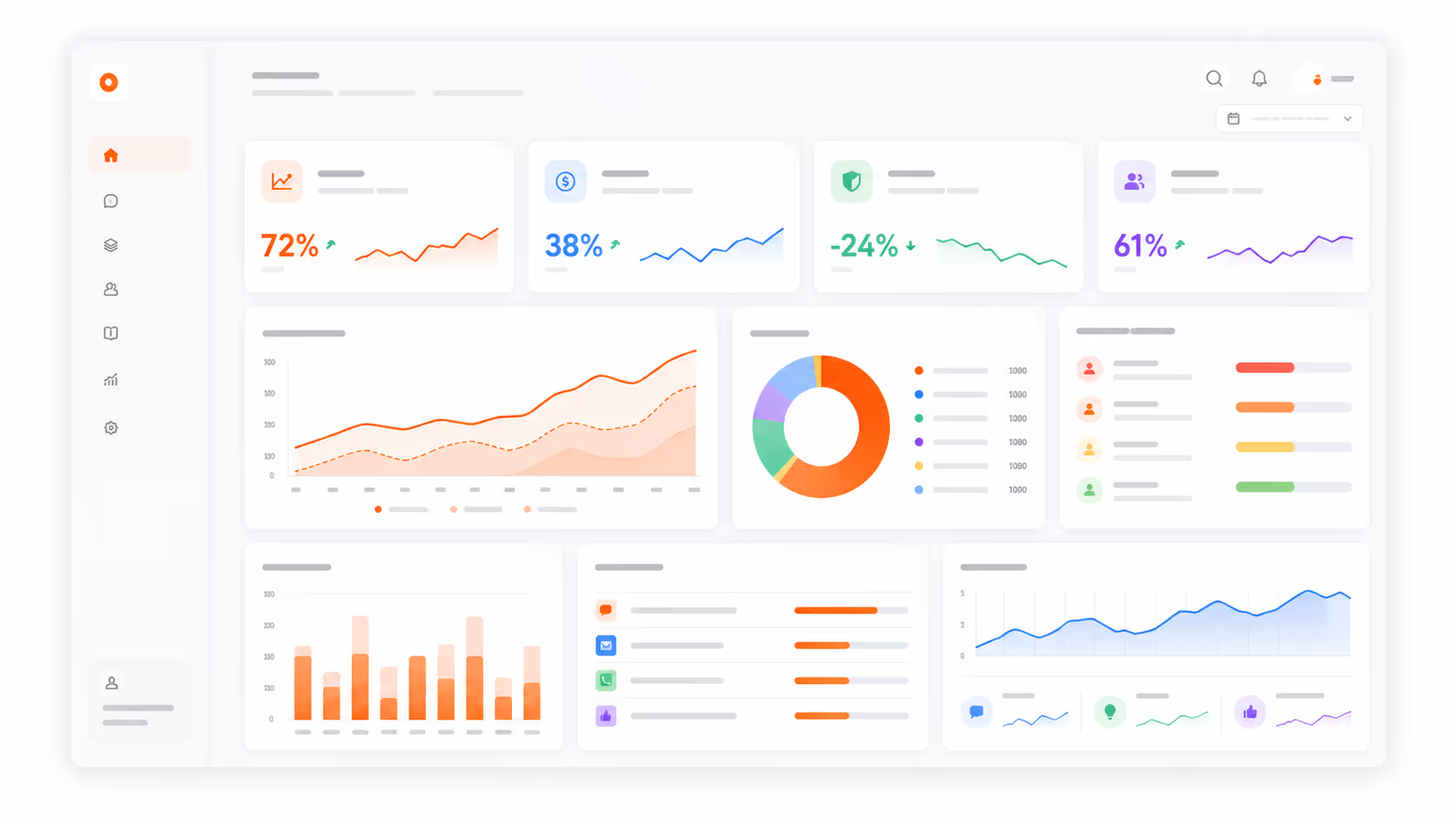
A useful support ROI dashboard connects service activity to retention, expansion, churn risk, and product improvement signals.
2. Invest in self-service infrastructure
The 80x cost difference between live and self-service support is too large to ignore. But self-service is not just about saving money. It is about meeting users where they are.
Most B2B SaaS users prefer to solve problems themselves if the resources exist. Build a knowledge base that is searchable, up-to-date, and integrated into your product. Add in-app guidance for common workflows. Create video walkthroughs for complex features.
At Apploye, improving self-service resources reduced support ticket volume while simultaneously improving user satisfaction. Users did not want to wait for a reply. They wanted an answer now.
3. Train support teams as growth partners
Support agents talk to more customers in a week than most product managers talk to in a quarter. Train them to:
- Identify expansion signals (usage limits, team growth, feature requests from higher tiers)
- Spot churn risk indicators (declining usage, frustration patterns, competitor mentions)
- Capture product feedback in a structured, actionable format
- Understand the business context of what they are supporting, not just the technical workflow
The shift is from “resolve the ticket” to “resolve the ticket and capture the signal.”
4. Build the support-to-product pipeline
Create a structured process for support insights to flow into product decisions. This does not need to be complex. A weekly tagged ticket report, a monthly trends review with product leadership, and a shared dashboard tracking support-surfaced issues through to resolution is enough to start.
The goal is to make support data a first-class input into your roadmap, not an afterthought.
5. Layer in AI strategically
Start with the highest-volume, lowest-complexity ticket categories. Measure deflection quality, not just deflection rate. Use the savings to reinvest in human agents who can focus on the complex, high-value interactions that drive retention and expansion.
The Google Trends signal: why this matters now
Search interest in customer support ROI, customer success metrics, and support-driven growth has been climbing steadily. The trend is not accidental. It reflects a broader shift in how SaaS companies think about growth.
As acquisition costs continue to rise and the era of growth-at-all-costs fades, the companies that win will be the ones that extract more value from existing customers. And the team best positioned to drive that, the team that talks to customers every single day, is support.
The global customer success platforms market was valued at approximately $1.86 billion in 2024 and is projected to reach around $9.17 billion by 2032, growing at a 22.1% CAGR. That growth is not coming from companies cutting support budgets. It is coming from companies investing in support as a strategic function.
What happens when you get this right
The compounding effect of treating support as a growth function is hard to overstate.
Better support drives better retention. Better retention drives higher NRR. Higher NRR drives higher valuation. Better support data drives better product decisions. Better product decisions reduce future support volume. The whole system reinforces itself.
I have seen this loop work at multiple companies. The ones that figured it out did not just build better support teams. They built better products, retained more customers, and grew faster with lower acquisition costs.
The ones that kept treating support as a cost center kept cutting budgets, losing customers, and wondering why growth was stalling.
Frequently asked questions
Common questions about measuring and maximizing the ROI of customer support in SaaS.
How do I measure the ROI of customer support in SaaS?
Track the connection between support quality and retention metrics. Measure support-influenced churn saves, expansion revenue from support-identified opportunities, deflection rates from self-service, and changes in NRR correlated with CSAT improvements. The strongest signal is the gap between retention rates for customers who contact support and get fast, effective help versus those who do not.
What percentage of revenue should a SaaS company spend on customer support?
The median spend is around 8% of ARR for combined customer support and customer success. Mid-market SaaS companies with a mix of assisted and self-service support typically fall between 4% and 8% of ARR. The right number depends on your product complexity, customer segment, and how much of your support you can shift to self-service.
When should a SaaS company invest in AI for customer support?
Invest in AI when your ticket volume is high enough that automation creates meaningful savings, and when you have enough historical data to train effective models. Most companies see the best results when AI handles repetitive tier-one queries while human agents focus on complex, relationship-building interactions. The break-even timeline is typically four to seven months.
How does customer support directly impact product growth?
Support drives growth through three channels: retention, which protects your revenue base and compounds over time; expansion, where support conversations surface upsell and cross-sell opportunities; and product improvement, where support data reveals the friction points and feature gaps that matter most to paying users.
What is the difference between customer support and customer success in SaaS?
Customer support is reactive, responding to issues and questions as they come in. Customer success is proactive, working to ensure customers achieve their goals before problems arise. Both drive retention, but the best SaaS companies integrate them so support insights feed into success strategies and success workflows reduce support volume over time.
How do I convince leadership that support is a growth investment, not a cost?
Show the math. Track the revenue saved from churn prevention, the expansion revenue from support-identified opportunities, and the product improvements driven by support data. Compare the cost of losing a customer to the cost of keeping one. When leadership sees that support-influenced accounts retain and expand at higher rates, the investment case makes itself.
Support is the growth lever hiding in plain sight
Every SaaS company is looking for growth advantages. Most look outward: new channels, new markets, new features. The companies that pull ahead are the ones that also look inward, at the team that already talks to every customer, already knows where the product falls short, and already has the relationships that drive retention.
Customer support is not overhead. It is infrastructure. And the ROI is there for anyone willing to measure it.