How to Define MVP Scope for a B2B SaaS Product
Learn what MVP scope means and use a practical B2B SaaS framework and checklist to define one user, workflow, outcome, and clear exclusions.
In this article
-
MVP Scope: A B2B SaaS MVP is not the smallest product you can ship. It is the smallest complete workflow that proves a specific business outcome.
-
Narrow First: Start by narrowing the user, use case, and workflow. Broad MVPs create vague feedback and slow product decisions.
-
Workflow Over Features: Scope should be built around the first workflow a customer needs to complete, not a wishlist of disconnected features.
-
Exclusions Matter: The most useful MVP scope documents clearly state what is intentionally excluded so the team can protect focus.
-
Clear Signal: A good MVP gives you enough proof to decide whether to deepen, reposition, or stop the product direction.
What is MVP scope?
MVP scope is the smallest set of work that lets one defined user complete one valuable workflow and reach a measurable outcome. It is not a feature wish list or a reduced version of the eventual product. It is a boundary for the first test: what must be true for a customer to experience value, what the team will learn, and what is intentionally left out.
For B2B SaaS, a useful scope statement names four things: the first user, the job they need to do, the end-to-end workflow, and the success signal. The framework below turns that statement into a buildable plan.
Most MVPs become too large for one simple reason: every stakeholder is trying to protect against a different risk.
Sales wants the feature that will help close the first deal. Support wants fewer future tickets. Engineering wants enough architecture to avoid rework. Leadership wants the product to feel credible. The founder wants the market to take the idea seriously.
All of those concerns are valid. But when they all go into the first version, the MVP stops being a learning tool and becomes a half-built version of the future product.
That is dangerous in B2B SaaS because the product usually has real workflow complexity. Users are not just clicking around for curiosity. They are trying to manage work, teams, money, operations, customers, approvals, reports, or compliance. If the MVP is too small, it feels useless. If it is too broad, it takes too long to ship and produces noisy feedback.
The job is not to build less. The job is to scope the first version around the smallest workflow that can prove value.
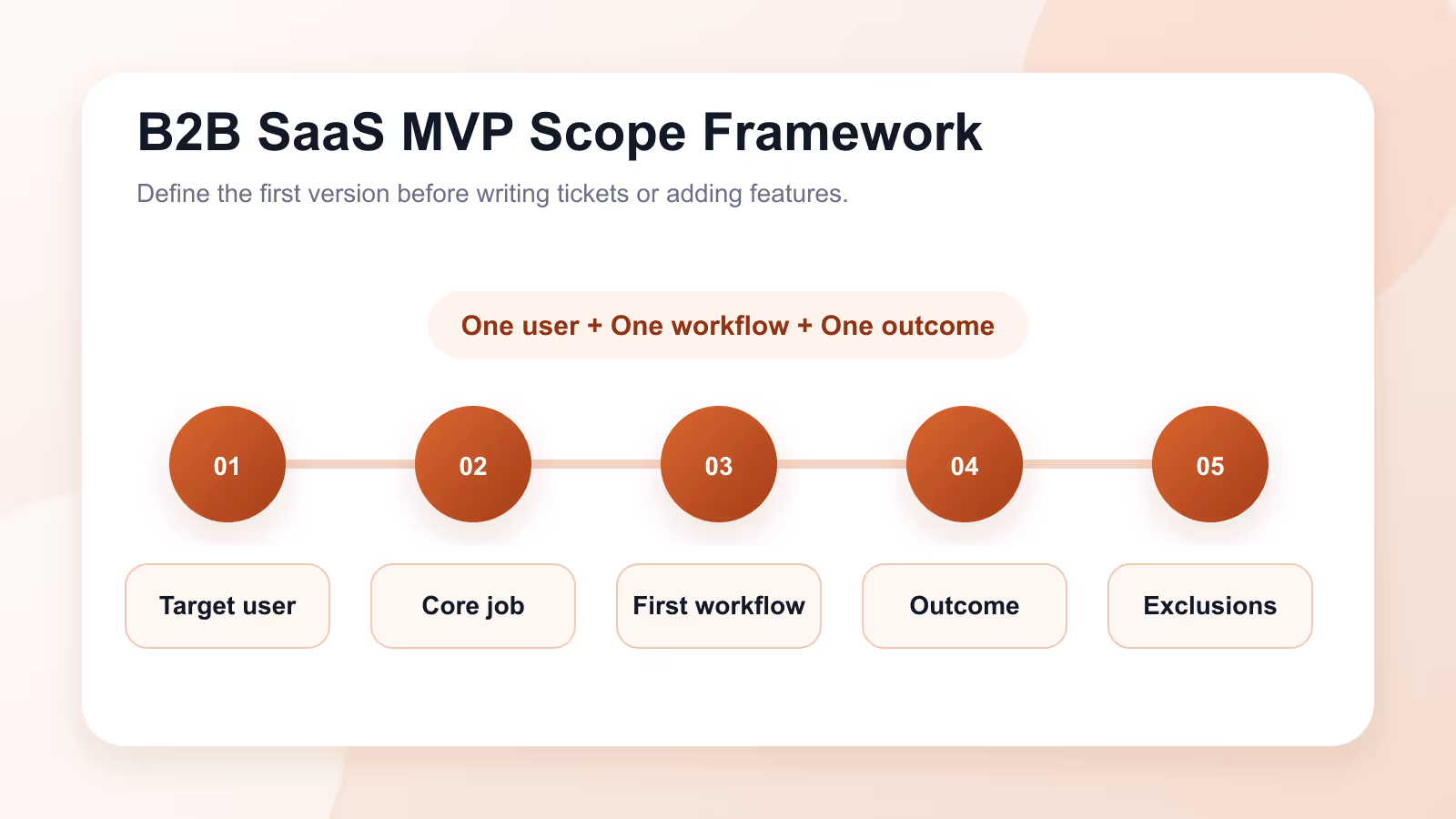
A focused B2B SaaS MVP scope starts with one user, one workflow, and one measurable product outcome.
Why MVP scope fails in B2B SaaS
B2B SaaS MVPs usually fail for one of five reasons.
The audience is too broad. A product for “small businesses” or “field teams” sounds focused, but it is still too wide. A dispatcher, owner, technician, operations manager, and finance user all experience the problem differently.
The workflow is unclear. Teams list features before they define the job the user needs to complete. That creates a product that has screens but no clear path to value.
Stakeholders confuse credibility with completeness. A B2B product needs to feel trustworthy, but that does not mean every advanced report, permission, integration, and automation belongs in version one.
The MVP tries to validate too many assumptions. If the first release tests the audience, pricing, workflow, positioning, onboarding, reporting, and automation model at the same time, the team will not know what caused the result.
The team forgets the post-launch loop. MVP scope should include how you will learn after launch. Without that, shipping becomes the goal instead of validation.
This is why a launch plan alone is not enough. The product needs strategic focus before execution. I covered the launch side in Product Launch Strategy: A PM’s Guide to Planning, Launching, and Scaling, but launch quality depends heavily on whether the MVP was scoped properly in the first place.
What MVP scope actually means
A B2B SaaS MVP is the smallest version of the product that lets one target customer complete one meaningful workflow and gives your team enough evidence to make the next product decision.
That definition matters because it changes the question.
The weak question is:
What features do we need for V1?
The better question is:
What complete workflow must exist for the first target user to experience the core value?
A complete workflow does not mean a complete product. It means the user can move from problem to outcome without hitting a missing step that breaks the value proposition.
For example, if you are building field service software, the MVP may not need advanced payroll, inventory, route optimization, customer portals, and custom reports. But it may need a complete path for creating a job, assigning it to a technician, tracking status, and confirming completion. Without that path, the user cannot validate the core operational value.
The wrong way to define MVP scope
The most common approach looks like this:
- Collect feature requests from stakeholders.
- Put them in a spreadsheet.
- Mark items as must-have, should-have, or nice-to-have.
- Argue until the list looks smaller.
- Call the remaining list the MVP.
That process feels practical, but it starts from the wrong unit: features.
Features are not useless, but they are not the best starting point. A feature list does not explain the user, sequence, context, priority, or success condition. It also makes every cut feel like a loss.
A stronger process starts with the workflow. Once the workflow is clear, features become easier to judge. They either help the target user reach the first outcome or they do not belong in the first version.
This is also where support and customer-facing signals matter. Support tickets can reveal what users actually struggle to complete, not just what they say they want. I wrote about that product signal in Customer Support Is Your Best Growth Lever.
The 5-part MVP scope framework
Most scoping frameworks focus on prioritization. This one focuses on validation. The goal is not to produce a smaller feature list - it is to produce a testable thesis: one user, one workflow, one outcome. Each part builds on the last, so skipping ahead creates gaps that surface during build.
Use this framework before writing detailed specs. If you cannot answer these five parts clearly, the MVP is probably not scoped tightly enough.
1. Define the target user
Do not start with the company type. Start with the person.
Weak target:
Field service companies.
Stronger target:
Operations managers at small field service companies who need to assign jobs and track technician progress during the day.
The stronger version gives you product direction. It tells you what the first workflow should support, what context the user is in, and what tradeoffs matter.
Ask:
- Who feels the pain most often?
- Who has urgency to solve it?
- Who will use the product directly?
- Who will decide whether the product is worth keeping?
- Which user should the first release satisfy before anyone else?
In B2B SaaS, the buyer and user may be different people. For MVP scope, prioritize the user workflow first, then make sure the buyer can understand the value.
2. Define the core job-to-be-done
The core job is not the feature. It is the progress the user is trying to make.
Weak job:
Manage tasks.
Stronger job:
Assign today’s field jobs to the right technician and know which work is delayed before customers complain.
That second version tells you what matters: assignment, visibility, status, delay signals, and customer impact.
Ask:
- What problem is painful enough that the user will change behavior?
- What does the user currently use instead?
- What result would make them say, “This is useful”?
- What failure would make the product irrelevant?
A strong MVP is not built around everything the product could eventually do. It is built around the job that proves the product deserves to exist.
3. Map the first workflow
Once the target user and job are clear, map the first workflow as a sequence.
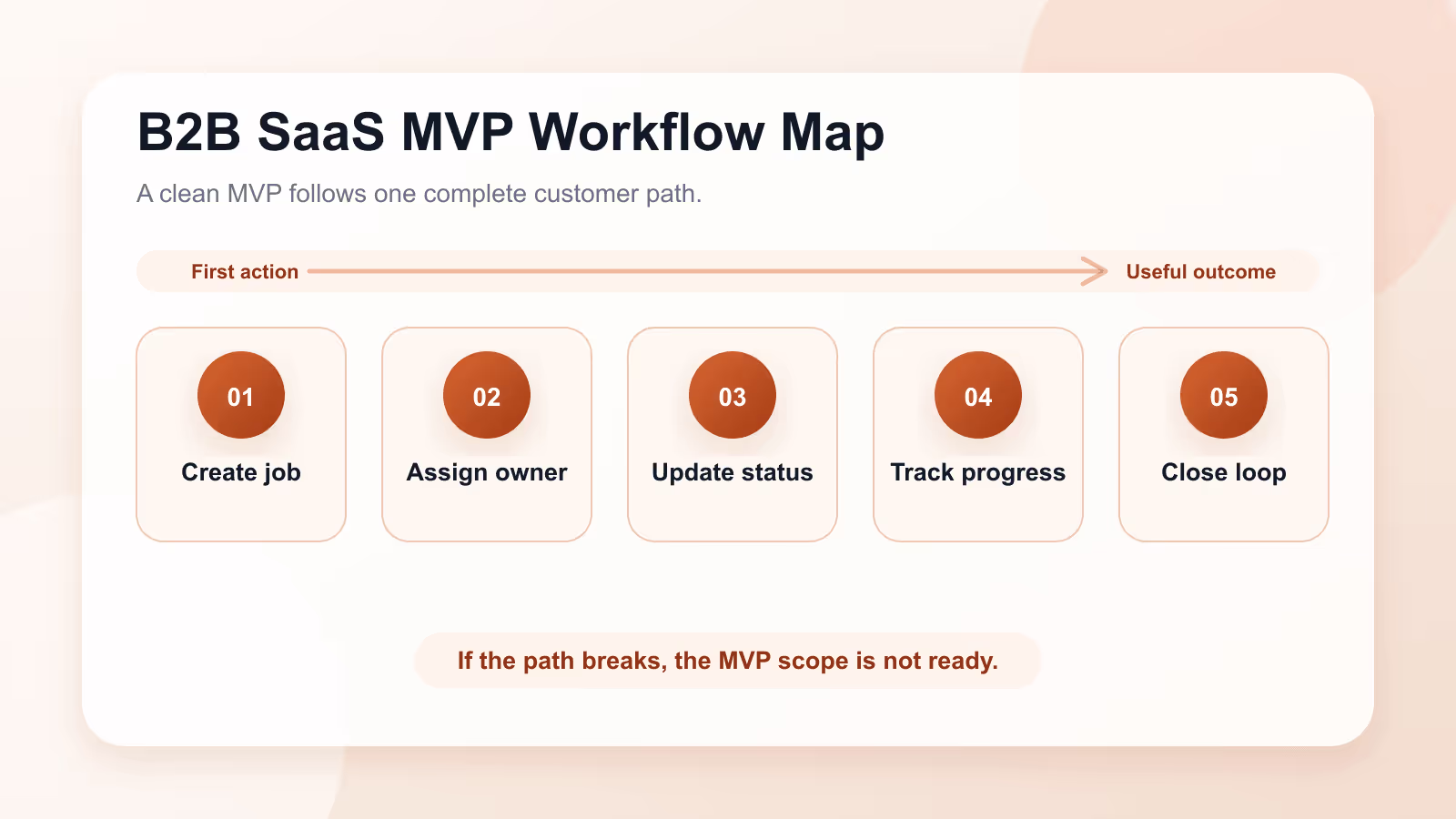
A launchable MVP should support one complete customer workflow instead of a disconnected feature list.
Example:
- Create a job.
- Add customer or location details.
- Assign the job to a technician.
- Technician sees the job.
- Technician updates status.
- Operations manager tracks progress.
- Completed job is recorded.
Now the team can discuss scope with more precision. The question becomes: what is required for this workflow to work well enough for a real customer?
This prevents two bad outcomes.
First, it stops the team from adding disconnected features that do not support the first workflow.
Second, it prevents the MVP from being too thin. If a missing step breaks the workflow, it is not a good cut.
4. Define the must-have outcome
The MVP should prove one outcome. Not ten.
For a field service product, the outcome might be:
A manager can assign and track daily field work without relying on scattered calls, spreadsheets, or manual status checks.
For a SaaS analytics product, the outcome might be:
A marketing lead can see which pages are losing visibility in AI-generated answers and decide what to update first.
For an onboarding product, the outcome might be:
A product team can identify where new users drop before reaching activation.
The must-have outcome becomes your filter. If a feature does not help prove that outcome, it is a candidate for later.
This also connects MVP scope to measurement. You should know what signal you expect after launch: activation, completed workflows, repeat usage, fewer manual steps, faster setup, better visibility, or higher conversion.
5. Write the exclusion list
This is the step most teams skip.
A good MVP scope document should include a clear list of what is intentionally excluded from version one.
Examples:
- Advanced role permissions.
- Custom report builder.
- Multi-location hierarchy.
- Complex billing rules.
- Bulk import/export.
- Native mobile app.
- Deep third-party integrations.
- White-label settings.
The point is not to ignore these forever. The point is to protect the first release from becoming unfocused.
An exclusion list also reduces stakeholder anxiety. Instead of saying “no” vaguely, you are saying: “Not in this validation cycle, because it does not affect the first workflow we are testing.”
This matters for pricing and revenue decisions too. Some features feel important because they appear to unlock bigger deals, but they can also distort the first product test. That same visibility problem shows up in pricing decisions, which I covered in How Discounts Impact SaaS Revenue and Retention.
Example: narrowing a broad field-service idea into a launchable workflow
Imagine the first idea is:
We need a field service management platform.
That is not MVP scope. That is a category.
A full field service platform could include scheduling, dispatching, GPS tracking, route optimization, timesheets, job photos, customer communication, invoices, payroll, inventory, reports, permissions, mobile apps, integrations, and more.
Trying to build all of that as an MVP would create a slow, expensive, unclear first release.
A tighter MVP scope might be:
Help small field service managers assign daily jobs to technicians and track job status from one dashboard.
Now the scope becomes more concrete.
Target user:
Operations manager at a small field service company.
Core job:
Assign and monitor daily jobs.
First workflow:
Create job, assign technician, technician updates status, manager monitors progress, job is marked complete.
Must-have outcome:
The manager has reliable visibility into today’s field work without calling each technician manually.
Intentional exclusions:
Advanced payroll, customer portal, route optimization, inventory, custom reports, and accounting integrations.
That is still useful. It is also much easier to launch, learn from, and improve.
MVP scope checklist
Before moving from scope to build, answer these questions.
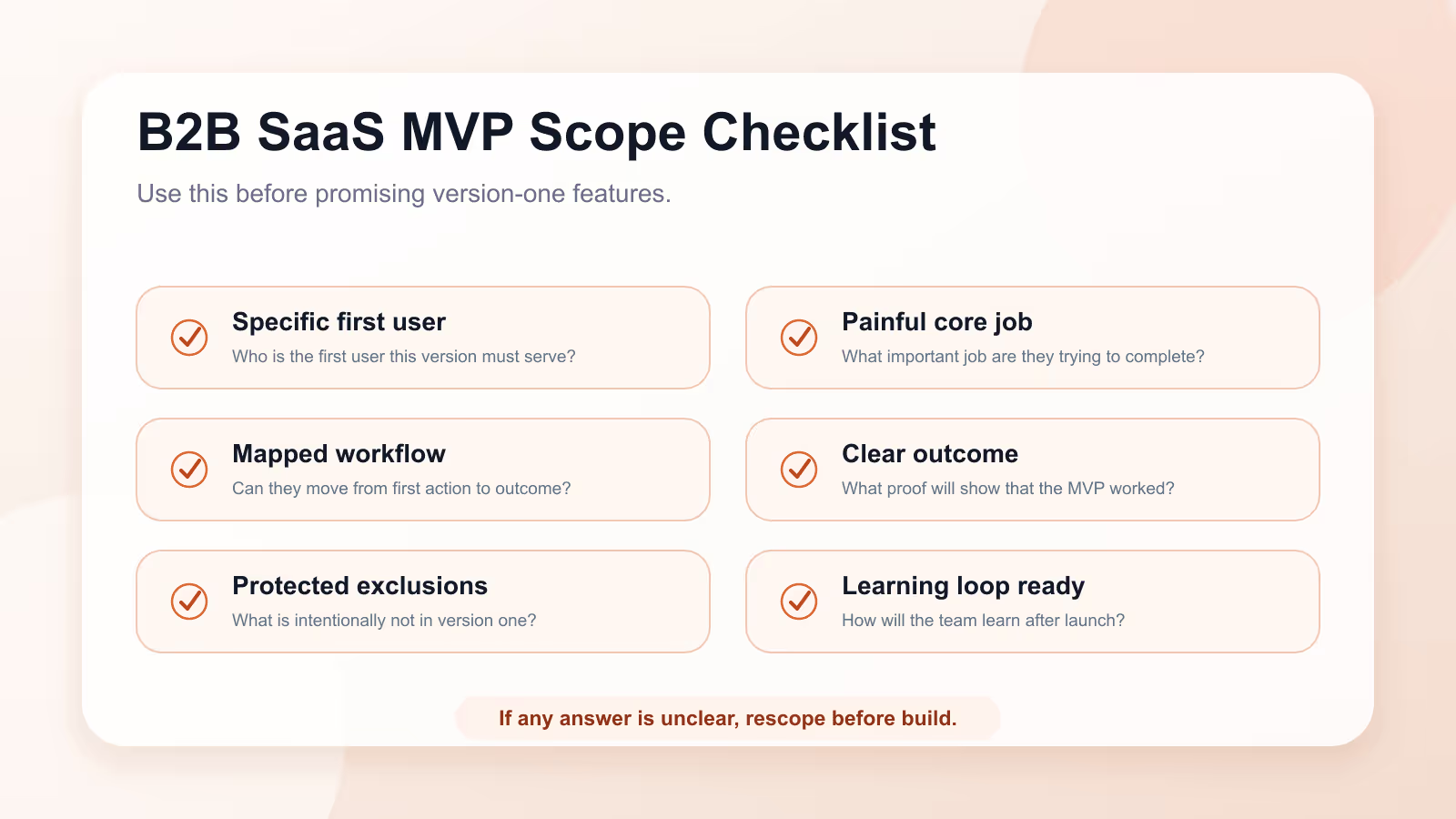
Use this checklist before writing tickets, building screens, or promising version-one features.
- Can we name the first target user in one sentence?
- Can we describe the painful job they need to complete?
- Can we map the first workflow from start to finish?
- Can the user reach a real outcome without a manual workaround that breaks trust?
- Do we know which assumptions this MVP is testing?
- Do we know what is intentionally excluded?
- Do we know what metric or signal will tell us whether the MVP worked?
- Do we know what we will do in the first two weeks after launch?
If the answer to any of these is unclear, the team probably needs one more scoping pass before writing detailed tickets.
If you need to turn the framework into a working document, use this B2B SaaS MVP scope template. It includes a feature challenge card, scope-change log, and 14-day validation plan so the document stays useful after kickoff.
How to align stakeholders on MVP scope
Defining scope internally is one problem. Getting stakeholder agreement is another.
The most reliable approach is to frame the MVP not as a limited product, but as a controlled test. You are not saying “we will not build that.” You are saying “we cannot learn whether that matters until we validate this first.”
A few tactics that help:
Share the exclusion list proactively. Stakeholders who see their ideas on the exclusion list - with a reason - are less likely to fight for inclusion. The reason does not have to be elaborate. “Not relevant to the first workflow we are validating” is enough.
Anchor the conversation on the must-have outcome. If a feature does not help the first target user reach the stated outcome, it has no logical claim on V1. That reframes scope debates from opinion to evidence.
Set a review date. Stakeholders accept MVP scope more easily when they know there is a fixed point - usually 6 to 10 weeks post-launch - where scope decisions will be revisited based on actual usage data.
Name the assumption each feature is testing. If a stakeholder wants a feature, ask which assumption it validates. If the answer is vague, it probably belongs in a later cycle.
What to do after scope is defined
Once MVP scope is clear, do not jump straight into a full build backlog. Move in this order.
Prototype the riskiest workflow first. The riskiest part is usually the step where user understanding, data quality, or operational behavior could break.
Write user stories around the workflow. Keep stories tied to the target user and outcome, not internal system modules.
Define activation. Decide what action proves the user reached value. In a B2B SaaS product, activation is often a completed workflow, not account creation.
Prepare the feedback loop. Decide how you will collect early feedback: interviews, support tickets, analytics, session recordings, sales notes, or in-app behavior.
Plan the first iteration before launch. The first release will teach you something. Make sure the team has time reserved to act on it.
This is where MVP scope connects back to product launch strategy for B2B SaaS. A scoped MVP gives you a cleaner launch, clearer onboarding, and better post-launch learning. Once the first release is live, use the evidence to decide what to build next.
The real goal of MVP scope
The goal of MVP scope is not to make the product small. It is to make the learning sharp.
A good MVP helps the right user complete the right workflow and gives your team a clear signal about what to do next.
If users complete the workflow and come back, deepen the product.
If they understand the problem but struggle with the experience, improve the UX.
If they do not care about the outcome, revisit the audience or positioning.
If they need a different workflow entirely, rescope before building more.
That is the real value of a focused MVP. It turns a broad product idea into a decision-making system.
If you are not sure where to start, go back to the checklist above. If you cannot answer every question clearly, run one more scoping pass before writing tickets. A few hours of alignment at this stage is worth weeks of rework later.
What does MVP scope mean?
MVP scope means setting the boundary for the first release: the one user, valuable workflow, measurable outcome, and exclusions that will make the product test meaningful. It keeps the team focused on validating a real product assumption before investing in broader features.
How much should a B2B SaaS MVP include?
A B2B SaaS MVP should include the smallest complete workflow that helps one clear user reach one valuable outcome. It should not include every admin setting, edge case, report, or automation the future product may need.
What is the biggest mistake teams make when defining MVP scope?
The biggest mistake is scoping around features instead of a workflow. A list of features can look complete internally while still failing to help the target customer complete the job they actually care about.
Should an MVP be ugly but functional?
Not exactly. It does not need polish everywhere, but the core workflow must be understandable and trustworthy. In B2B SaaS, confusing UX can invalidate the test because users may reject the experience before they understand the value.
How do you know when MVP scope is too broad?
MVP scope is too broad when the team cannot clearly name the first user, first workflow, must-have outcome, and top three exclusions. It is also too broad when every stakeholder can add one more must-have without breaking the logic of the plan.
What should happen after MVP scope is defined?
After scope is defined, the team should turn the workflow into user stories, prototype the riskiest steps, define launch metrics, and prepare the post-launch feedback loop before building too much around unvalidated assumptions.
How long should it take to build a B2B SaaS MVP?
There is no universal answer, but if scoping is tight, most B2B SaaS MVPs take 6 to 14 weeks of focused engineering effort. Teams that scope around a single workflow and a clear exclusion list typically move faster because there is no ongoing debate about what counts as done.
What is the difference between MVP scope and a product roadmap?
MVP scope defines the boundaries of the first testable release - one user, one workflow, one outcome. A roadmap describes the sequence of releases after that first learning. Getting MVP scope right makes the roadmap easier to sequence because you know what you validated and what remains uncertain.